Towards Simple and Frontier
Vision-Language Navigation

Lingyi Hong1,*,†, Weiren Cai2,*, Jiayu Chen1,*, Xinyu Zhou2,†,‡, Bailin He1, Yunfei Guo1, Qiao Sun3, Xiang Liu1, Boyu Ma2, Jianfei Yang2, Wenqiang Zhang1

1 Fudan University 2 Nanyang Technological University 3 Lenovo Group Limited

* Equal contribution  ·  † Project leaders  ·  ‡ Corresponding author

How far can a native multimodal large language model go in VLN before introducing task-specific architecture?

76.7%R2R-CE · val-unseen SR
80.1%RxR-CE · val-unseen SR
293msModel-only latency · A100 · Qwen3-VL 4B
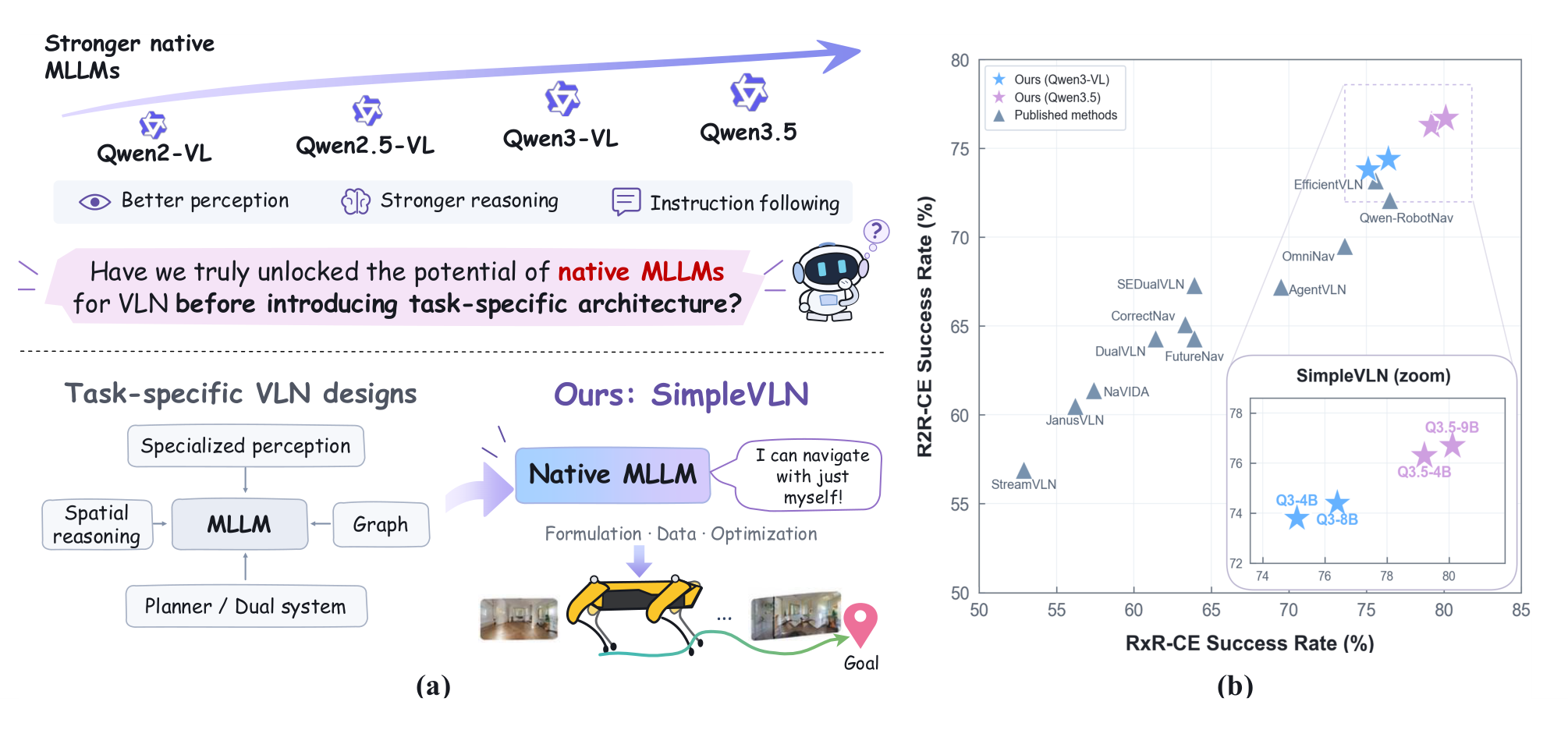
Motivation and performance comparison of SimpleVLN
Motivation and performance comparison of SimpleVLN. (a) Motivation for using native MLLMs in VLN. (b) Comparison with existing methods on R2R-CE and RxR-CE.

Existing methods often address these demands through task-specific architectures. As multimodal large language models (MLLMs) become increasingly capable, an important question remains: Have we truly unlocked the potential of native MLLMs for VLN before introducing task-specific architecture?

Exploring what matters for vision-language navigation.

Formulation Data Optimization

Abstract.

SimpleVLN explores how far native multimodal models can go in vision-language navigation through better formulation, data, and optimization, without task-specific architectural designs.

Read the full abstract

Vision-and-Language Navigation (VLN) requires embodied agents to ground language in visual observations and make long-horizon decisions. Existing methods often address these demands through task-specific architectures. As multimodal large language models (MLLMs) become increasingly capable, an important question remains: Have we truly unlocked the potential of native MLLMs for VLN before introducing task-specific architecture?

We present SimpleVLN, an architecture-preserving framework developed through studies of navigation formulation, data construction, and optimization. At the formulation level, SimpleVLN combines single-turn decision inputs with fixed-budget global–local memory to efficiently use navigation history without unbounded context growth, while action chunks enable efficient output of multiple primitive actions per model invocation. For data construction, we combine expert demonstrations with policy-dependent DAgger experience and develop a scalable synthesis pipeline that generates large-scale tasks for reinforcement learning. At the optimization level, a progressive IL–DAgger–RL pipeline advances from action imitation to task-level outcome optimization.

Comprehensive experiments validate the effectiveness of these three aspects. We instantiate SimpleVLN across multiple MLLM backbones and model sizes, demonstrating its generality. SimpleVLN achieves 76.7% and 80.1% success rates on the R2R-CE and RxR-CE splits, respectively, substantially outperforming existing methods. These results show that the navigation capabilities of native MLLMs can be effectively unlocked without task-specific architectural designs.
Qualitative
results.

We evaluate SimpleVLN on the R2R-CE and RxR-CE val-unseen benchmarks in Matterport3D with Habitat. We further evaluate SimpleVLN in real environments using a Daystar quadruped robot. The model runs onboard on an NVIDIA Jetson Thor GPU. SimpleVLN demonstrates strong navigation performance in unseen environments and follows multi-step instructions in diverse real-world scenes.

Simulation

Foyer
Living room
Gallery
Kitchen

Real world

Office hallwayTurn left and enter the first room
Yellow pillarStop next to the yellow pillar
KFC entranceWalk to the KFC entrance and stop
Vending machineStop at the vending machine
Outdoor pathFollow the stone path to the fitness area
Red carAvoid the pillar and stop at the red car
Follow the personSpot the person in black and follow

Adapting native
MLLMs to VLN.

SimpleVLN directly adapts off-the-shelf MLLMs to VLN without architectural modifications. We study native-MLLM navigation from three perspectives: navigation formulation, data construction, and a progressive optimization strategy that shifts from action imitation to outcome-driven learning through environment interaction.

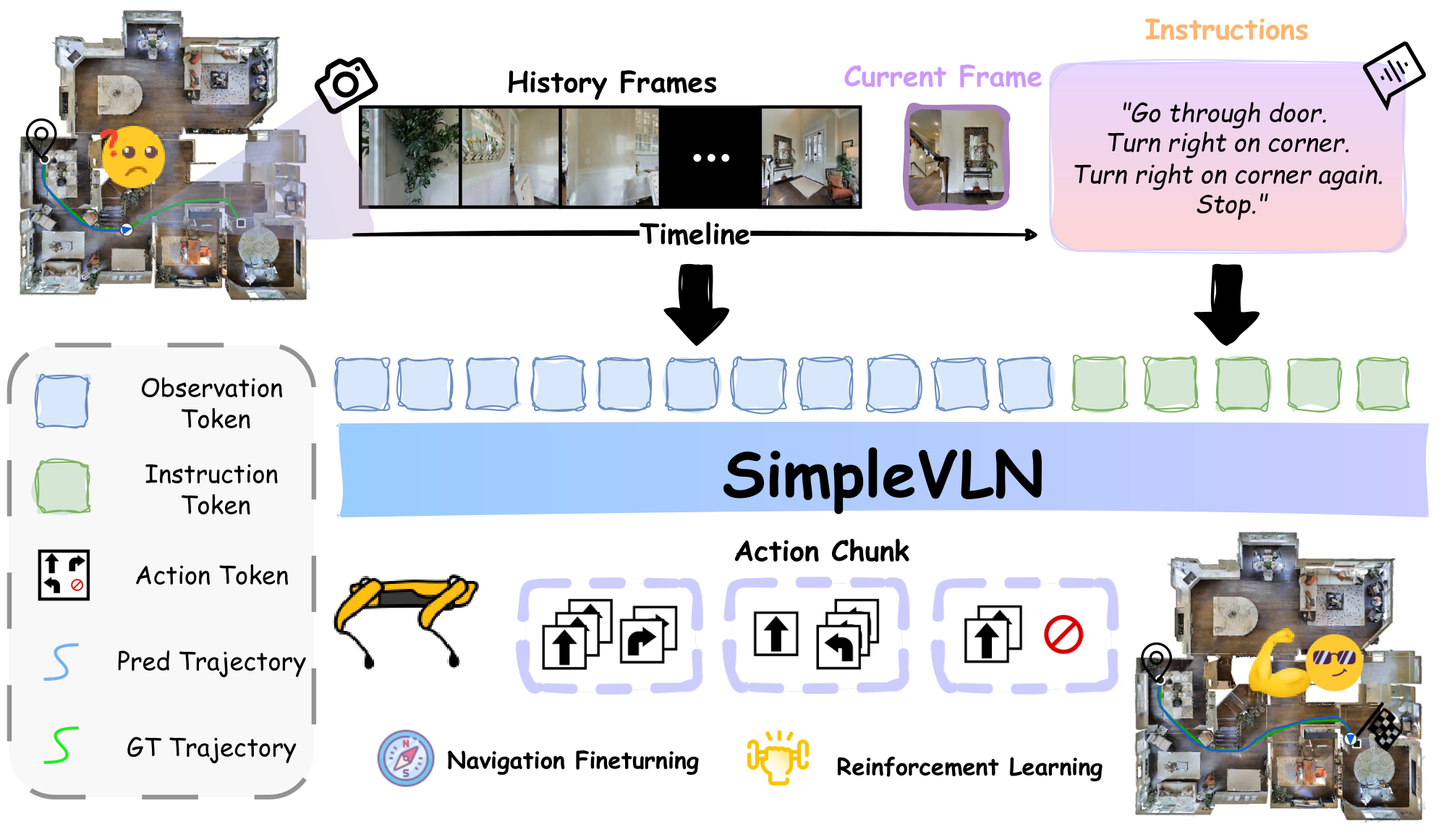
Overview of SimpleVLN
Overview of SimpleVLN. At each decision, sampled history frames, current observation, and the instruction are fed to an MLLM, which directly predicts an action chunk for navigation.

We construct a single-turn decision input from the instruction, current observation, and sampled visual history, excluding previous dialogue turns and past actions. Global–local history selection preserves recent continuity while sparsely covering earlier observations within a fixed budget. We use action chunking to predict an ordered sequence of primitive actions per invocation for sequential execution by the environment.

01Formulation

Decision inputs
and history management.

We combine single-turn decision inputs with fixed-budget global–local memory to efficiently use navigation history without unbounded context growth. Action chunking predicts multiple primitive actions per model invocation.

  • Single-turn decisions
  • Global–local memory
  • Action-chunk prediction
02Data

Demonstrations and
synthesized tasks.

We combine expert demonstrations with policy-dependent experience collected through DAgger, and develop a scalable task-synthesis pipeline to generate navigation tasks for reinforcement learning.

  • R2R + RxR + ScaleVLN
  • Policy-dependent DAgger
  • Scalable task synthesis
03Optimization

Progressive
IL–DAgger–RL training.

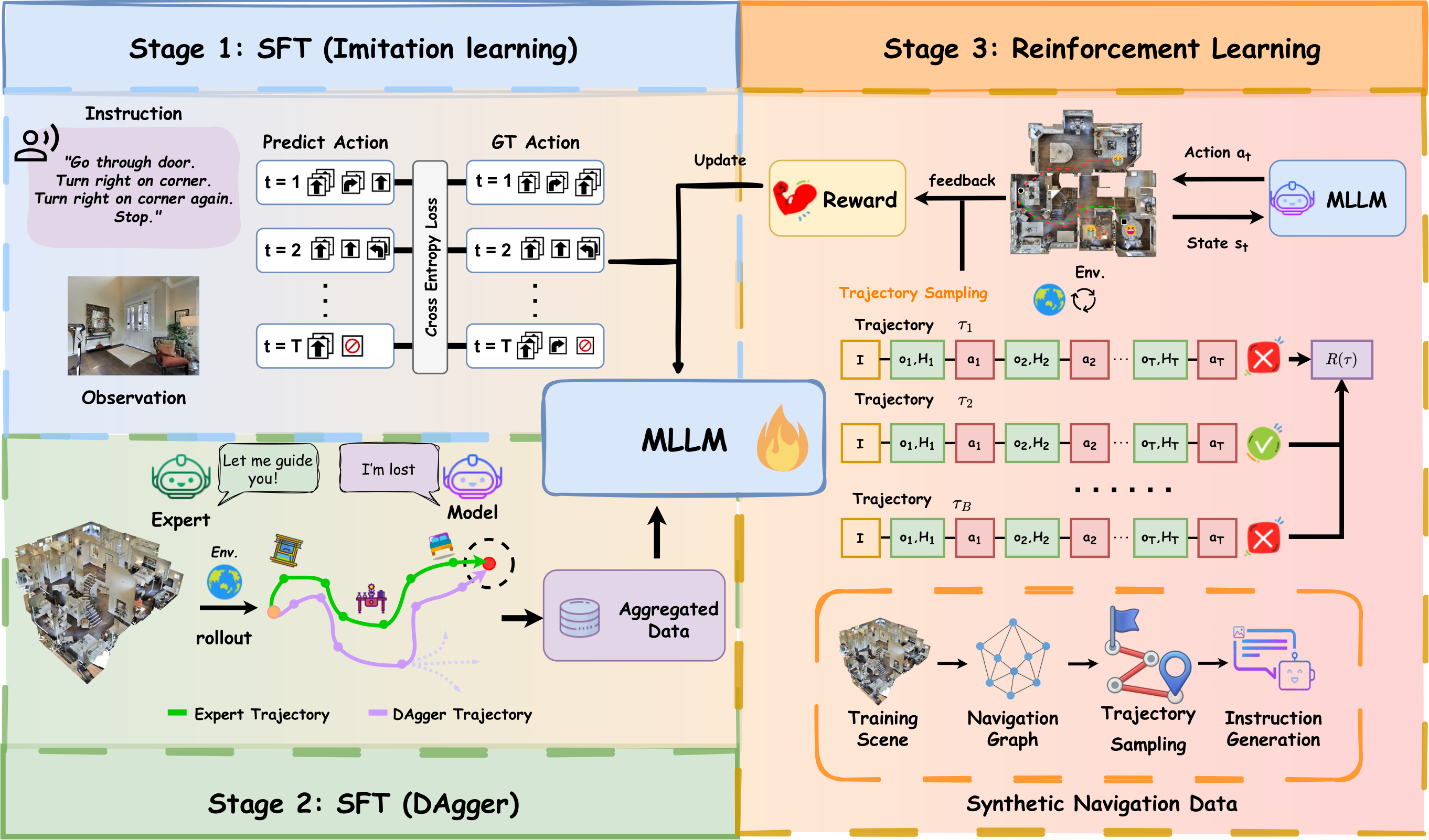
We investigate a progressive IL–DAgger–RL pipeline: imitation learning initializes the policy, DAgger adapts it to policy-induced states, and RL optimizes task-level outcomes through environment interaction.

  • Imitation learning
  • DAgger-based fine-tuning
  • Outcome-driven RL
Training pipeline of SimpleVLN
Training data pipeline of SimpleVLN. SimpleVLN first learns from expert demonstrations, then collects and aggregates corrective trajectories through DAgger. For RL, it synthesizes navigation episodes from sampled start–goal paths and generated instructions, then optimizes the policy through environment interaction and outcome feedback.

First, imitation learning uses expert demonstrations to learn navigation actions. Next, DAgger-based fine-tuning adapts the policy to states encountered during its own execution while retaining action-level supervision. Finally, reinforcement learning optimizes task-level outcomes through environment interaction on synthesized episodes, shifting the learning signal from demonstrated actions to outcome feedback.

Quantitative
results.

SimpleVLN achieves state-of-the-art navigation success while preserving the native MLLM architecture and using only first-person RGB observations. Strong results across model families and scales show that this approach can unlock navigation capabilities in a range of native multimodal models.

R2R-CEval-unseen · SR ↑
76.7%

Qwen3.5 9B

  • Qwen3-VL 4B73.8
  • Qwen3-VL 8B74.4
  • Qwen3.5 4B76.3
RxR-CEval-unseen · SR ↑
80.1%

Qwen3.5 9B

  • Qwen3-VL 4B75.1
  • Qwen3-VL 8B76.4
  • Qwen3.5 4B79.2
Inference latencyNVIDIA A100
293ms

Qwen3-VL 4B

SimpleVLN predicts each action chunk in 293 ms with Qwen3-VL 4B on an NVIDIA A100, while maintaining strong navigation without a slower model or task-specific architecture.

Comparison with state-of-the-art methods on the R2R-CE and RxR-CE val-unseen splits.

This comparison covers navigation accuracy, path efficiency, and observation requirements. SimpleVLN achieves strong performance using only first-person RGB, without task-specific architectural modifications. Consistent gains across backbones support the applicability of the training recipe beyond a single model. † and * denote results before and after RL, respectively.

Method Size Observation R2R-CE RxR-CE
Pano.Odo.DepthS.RGB NE↓OS↑SR↑SPL↑ NE↓SR↑SPL↑nDTW↑
NaVid7B5.4749.137.435.98.4123.821.2—
Uni-NaVid7B5.5853.347.042.76.2448.740.9—
NaVILA7B5.2262.554.049.06.7749.344.058.8
ActiveVLN3B5.3158.350.143.75.8450.741.258.1
StreamVLN7B4.9864.256.951.96.2252.946.061.9
NavFoM7B5.0164.956.251.25.5157.449.460.2
JanusVLN7B4.7865.260.556.86.0656.247.562.1
NaVIDA3B4.3269.561.454.75.2357.449.667.0
CorrectNav7B4.2467.565.162.34.0969.363.375.2
DualVLN7B4.0570.764.358.54.5861.451.870.0
FutureNav4B4.2470.265.461.34.6060.952.868.0
FutureNav8B4.2969.264.360.34.2663.954.869.1
AgentVLN3B3.8873.567.264.73.9269.561.374.6
OmniNav3B3.7474.669.566.13.7773.662.0—
SEDualVLN7B3.7573.767.362.54.1263.952.472.8
Qwen-RobotNav4B4.2273.666.960.54.1571.361.568.6
Qwen-RobotNav8B4.3672.765.759.64.1673.463.569.9
Qwen-RobotNav4B3.8077.269.563.63.8075.265.071.9
Qwen-RobotNav8B3.5378.572.166.63.5876.565.772.5
Efficient-VLN8B3.2978.273.265.03.1875.660.0—
SimpleVLN† (Qwen2.5-VL)3B5.7063.351.644.95.2050.342.057.6
SimpleVLN† (Qwen2.5-VL)7B4.8768.459.152.05.3158.949.262.9
SimpleVLN† (Qwen3-VL)4B4.2674.365.458.84.7963.454.166.5
SimpleVLN* (Qwen3-VL)4B3.3979.473.866.73.2975.165.371.5
SimpleVLN† (Qwen3-VL)8B4.4073.364.257.04.7364.254.366.2
SimpleVLN* (Qwen3-VL)8B2.9379.274.469.53.1176.466.477.4
SimpleVLN† (Qwen3.5)4B3.7677.567.159.24.3265.655.367.8
SimpleVLN* (Qwen3.5)4B2.7980.176.372.32.6179.269.780.3
SimpleVLN† (Qwen3.5)9B3.5976.969.261.24.4864.054.267.0
SimpleVLN* (Qwen3.5)9B2.6384.176.772.62.5180.169.979.8

Comparison with state-of-the-art methods on inference latency and navigation performance.

Latency is measured on R2R-CE using the same NVIDIA A100 GPU, and measures model execution only for one action-chunk decision, excluding preprocessing, environment execution, and other non-model overhead. SimpleVLN uses Qwen3-VL-4B as its backbone.

SimpleVLN combines high navigation success with low model latency. The comparison shows that stronger navigation does not require a slower decision model or additional task-specific architecture.

Method Size Latency (ms)↓ R2R-CE RxR-CE
NE↓OS↑SR↑SPL↑ NE↓SR↑SPL↑nDTW↑
StreamVLN7B3004.9864.256.951.96.2252.946.061.9
JanusVLN7B9064.7865.260.556.86.0656.247.562.1
DualVLN7B6834.0570.764.358.54.5861.451.870.0
FutureNav4B11414.2470.265.461.34.6060.952.868.0
SimpleVLN4B2933.3979.473.866.73.2975.165.371.5

Navigation
analysis.

We investigate how navigation formulation, data construction, and optimization affect VLN performance. The following experiments use controlled ablations of these three aspects.

Formulation

Navigation interface and memory design.

(a) Action chunking. Action chunking improves navigation performance, supporting it as an effective action-output representation rather than merely a way to reduce model invocation frequency.

(b) Single-turn navigation. Reconstructing each decision from the current observation and sampled visual history performs better than continually accumulating interaction history in multi-turn dialogue. Although multi-turn dialogue can preserve a fuller interaction history, continually appending observations and actions creates an overly long context that current MLLMs cannot effectively exploit for navigation.

(c) Observation sampling. Uniformly sampling global-history observations performs better than sampling only at action-chunk boundaries or retaining all primitive-step observations, favoring compact, uniformly sampled global history over retaining every frame.

Action format
Action formatNE↓OS↑SR↑
Primitive action5.254.545.6
Action chunk5.561.253.6
Dialogue format
Dialogue formatNE↓OS↑SR↑
Multi-turn5.955.235.7
Single-turn5.561.253.6
Observation sampling
Sampling schemeNE↓OS↑SR↑
Chunk6.155.246.3
Primitive (all)5.857.551.9
Primitive (8)5.561.253.6
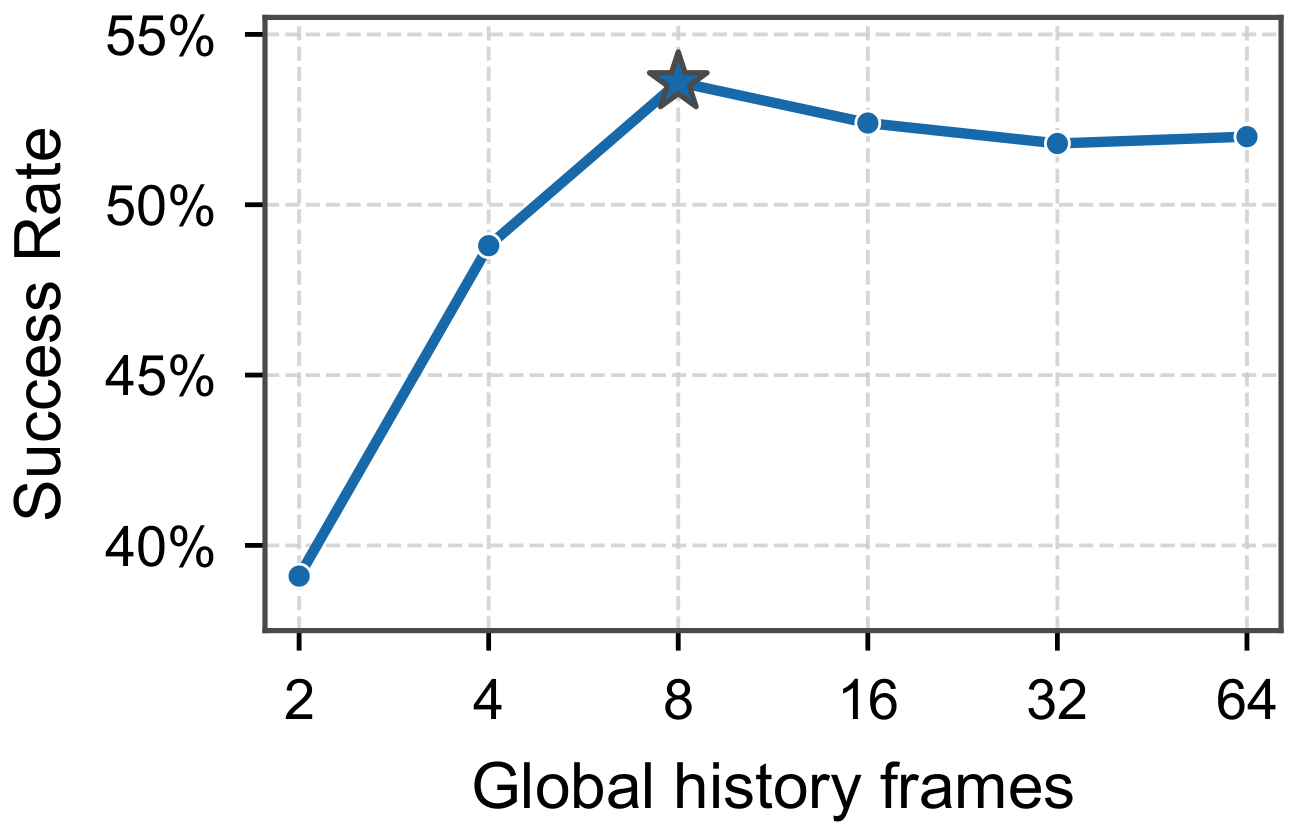
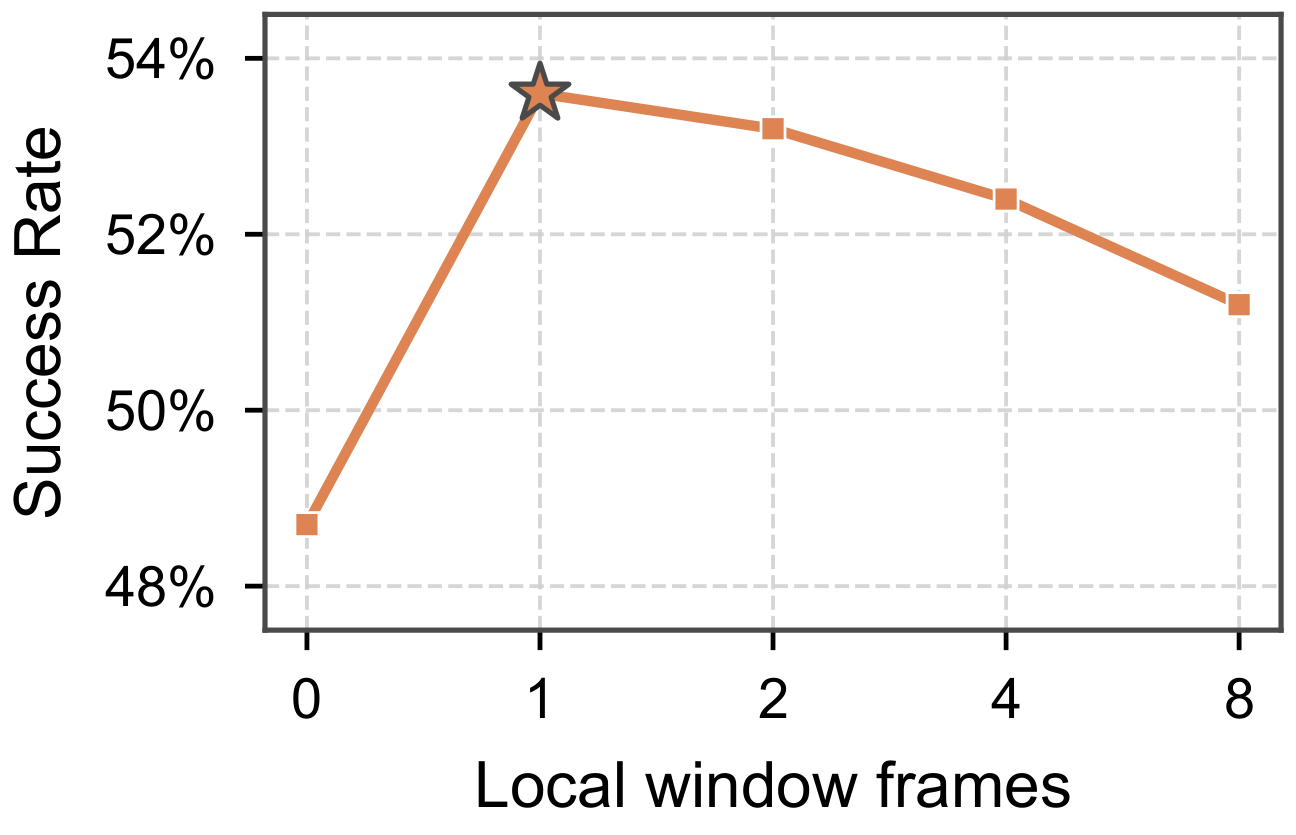
Global memory budget Local memory budget
Memory budget. Effect of global and local memory sizes on R2R-CE val-unseen SR. We vary M with N = 1 (left) and N with M = 8 (right); stars indicate the default configuration.

Excessive global history can introduce redundant or less relevant observations, while adding more local-history frames brings no further improvement. This highlights the importance of selecting useful history rather than simply increasing its size.

Data

Demonstration and DAgger data on the R2R-CE and RxR-CE val-unseen splits.

This table separates the contribution of broader expert demonstrations from experience collected by the learned policy. Combining demonstration sources improves navigation, but DAgger brings the largest additional gain. Expert routes alone do not cover all states the robot encounters during its own execution; policy-dependent trajectories provide valuable complementary supervision.

R2RRxRScaleVLNDAgger R2R SR↑R2R SPL↑ RxR SR↑RxR SPL↑
53.648.150.342.0
56.751.354.546.7
57.950.955.348.1
65.458.863.454.1

Synthesized RL data on the R2R-CE and RxR-CE val-unseen splits.

Synthesizing RL tasks from a mixture of R2R, RxR, and ScaleVLN scene pools performs best, suggesting that combining scene sources provides broader training coverage than relying on any single pool.

R2RRxRScaleVLN R2R SR↑R2R SPL↑ RxR SR↑RxR SPL↑
Pre-RL baseline65.458.863.454.1
68.563.265.855.3
67.559.368.559.5
66.661.366.356.2
69.463.869.760.8
70.165.671.062.1

Optimization

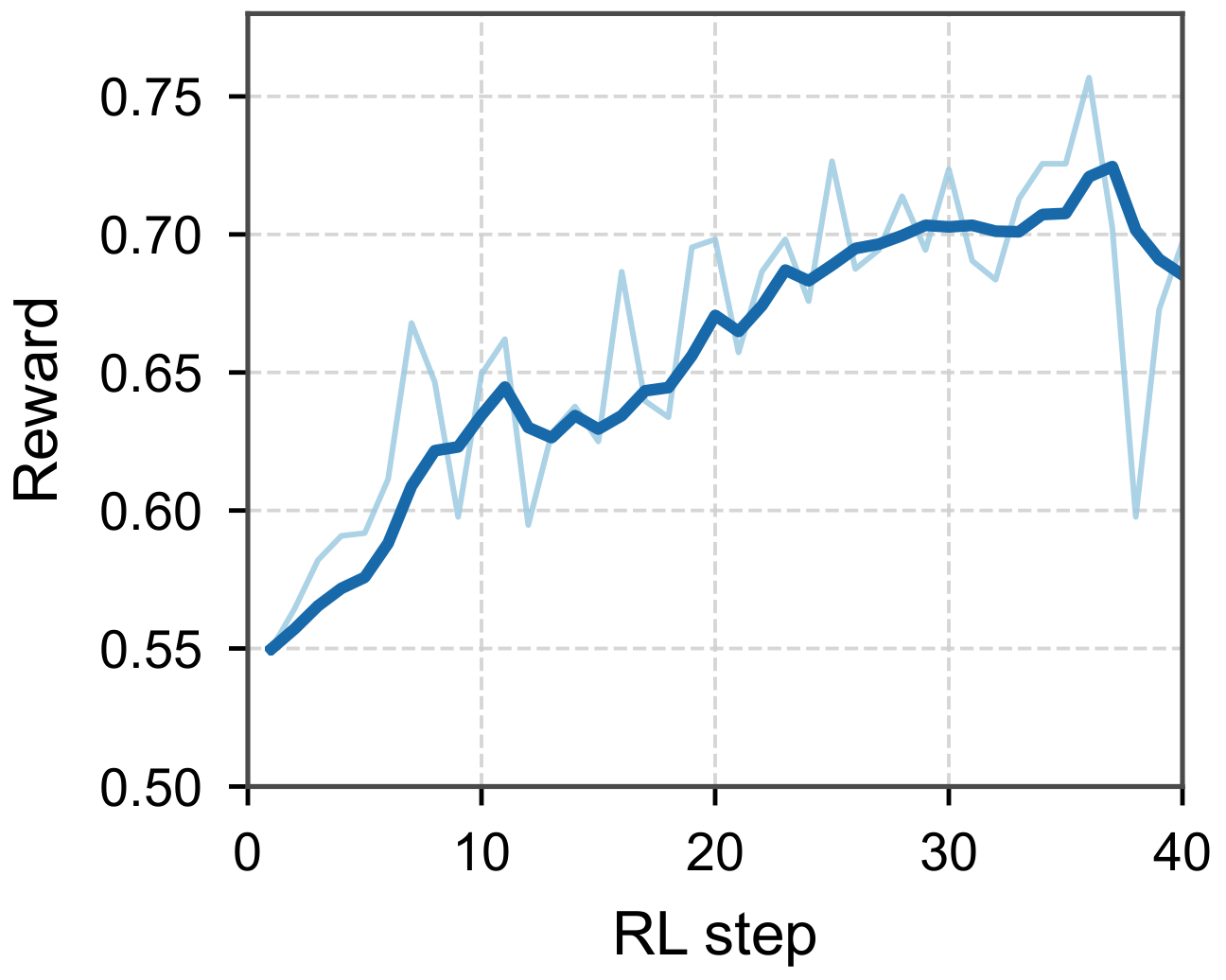
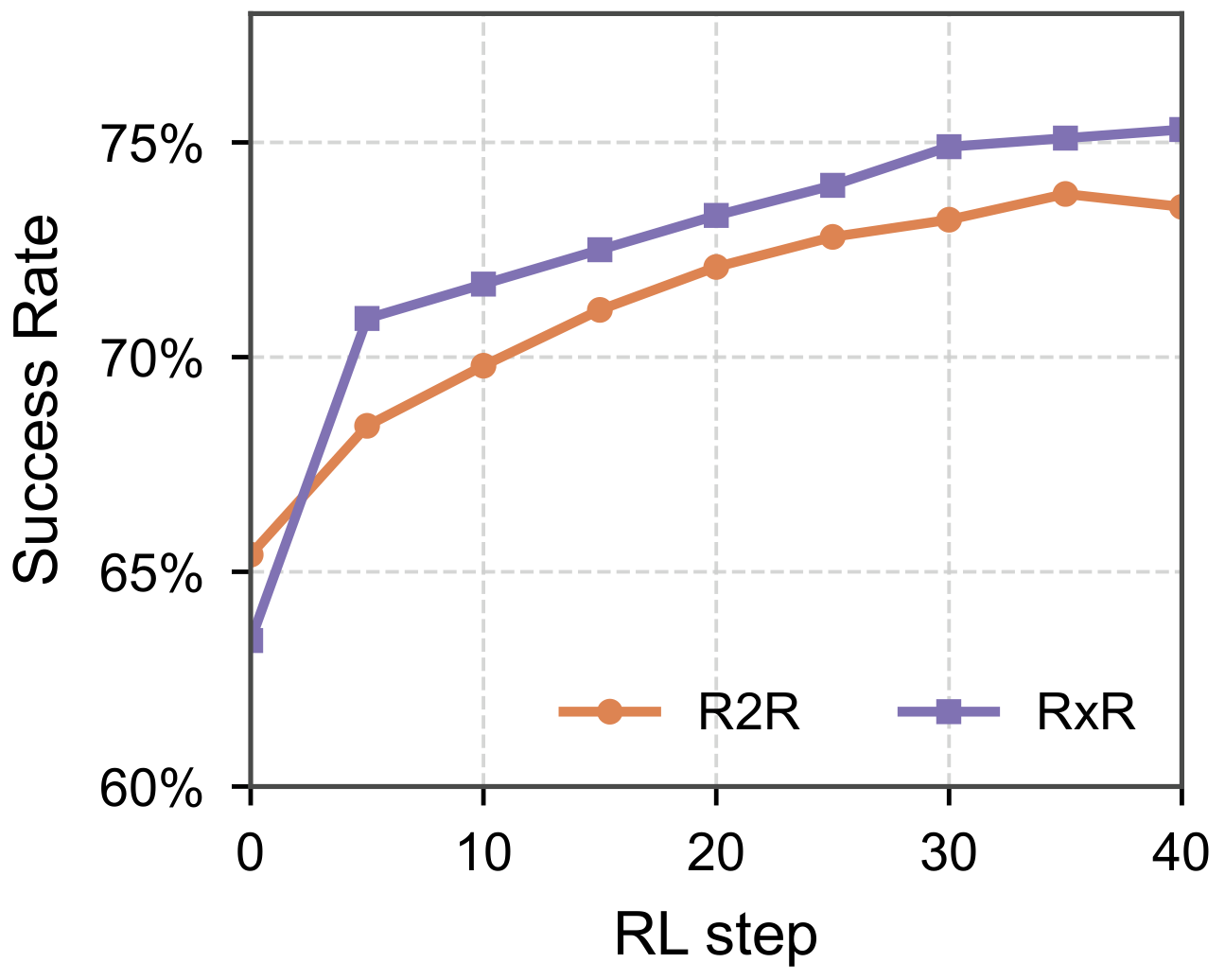
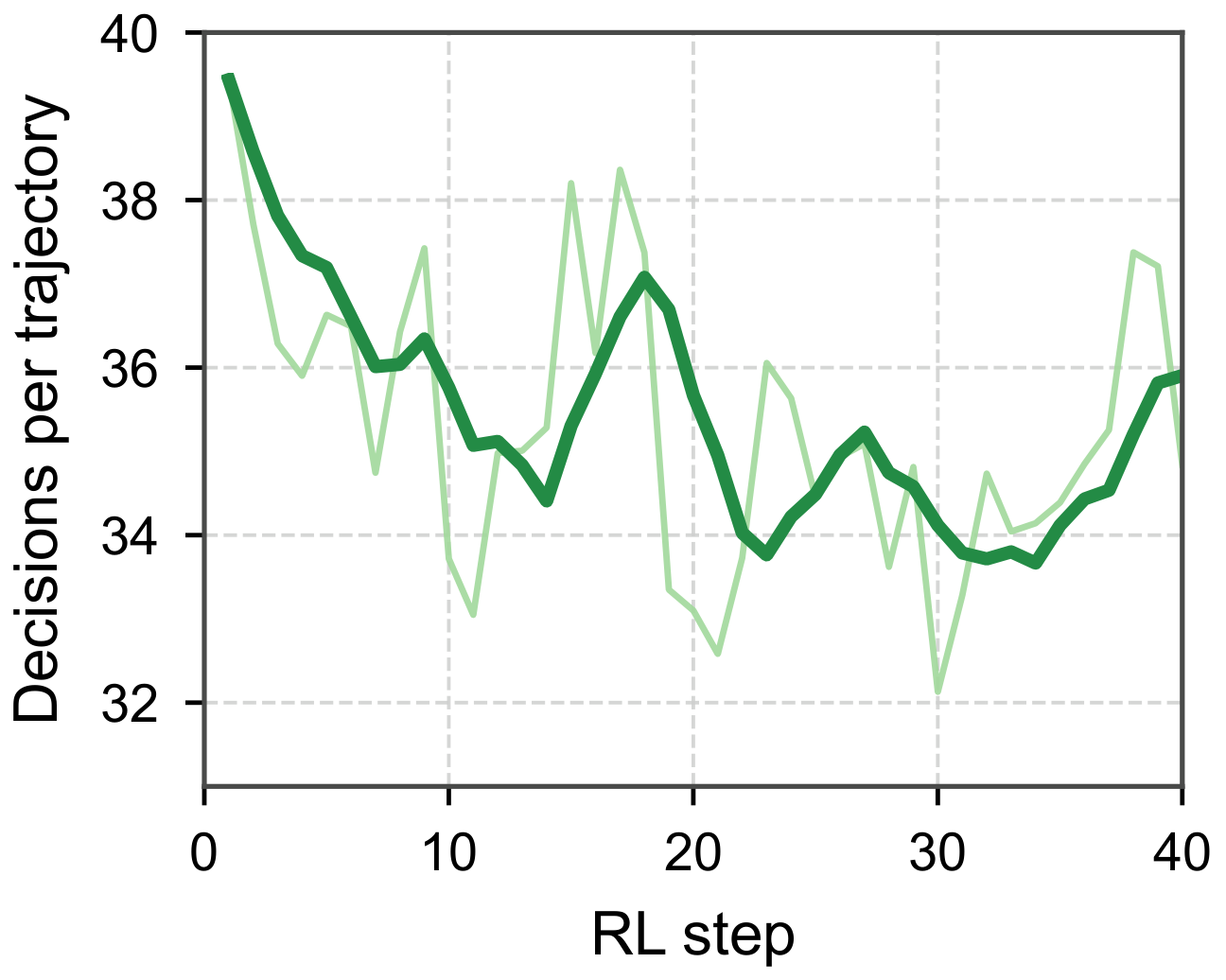
RL reward curve RL success-rate curve RL decision-length curve
RL training dynamics. Rollout reward, validation success, and the average number of action-chunk decisions track how the policy changes during environment interaction.

As training progresses, rollout reward and evaluation success rate generally increase, while the average number of action-chunk decisions per trajectory decreases.

Reward design and RL optimization on the R2R-CE and RxR-CE val-unseen splits with Qwen3-VL 4B.

Binary task-completion feedback achieves higher success rates on both benchmarks than an SPL-based reward, supporting simple task-completion feedback as an effective RL signal.

The evaluated DAPO configuration further improves navigation with binary success rewards. However, since the compared configurations differ in more than the optimizer, the gain cannot be attributed solely to the optimization algorithm.

RL configuration R2R SR↑R2R SPL↑ RxR SR↑RxR SPL↑
Pre-RL baseline65.458.863.454.1
GRPO + SPL(τ)68.963.167.758.3
GRPO + 1(success)70.165.671.062.1
DAPO + 1(success)71.565.373.764.0

BibTeX

@article{hong2027simplevln,
  title   = {SimpleVLN: Towards Simple and Frontier
             Vision-Language Navigation},
  author  = {Hong, Lingyi and Cai, Weiren and Chen, Jiayu
             and Zhou, Xinyu and He, Bailin and Guo, Yunfei
             and Sun, Qiao and Liu, Xiang and Ma, Boyu
             and Yang, Jianfei and Zhang, Wenqiang},
  year    = {2027},
  eprint  = {2610.23203},
  archivePrefix = {arXiv},
  primaryClass = {cs.RO},
  url     = {https://arxiv.org/abs/2610.23203}
}